Updated 2026-09-09 · 4 min read
What is liquid cooling?
Key takeaways
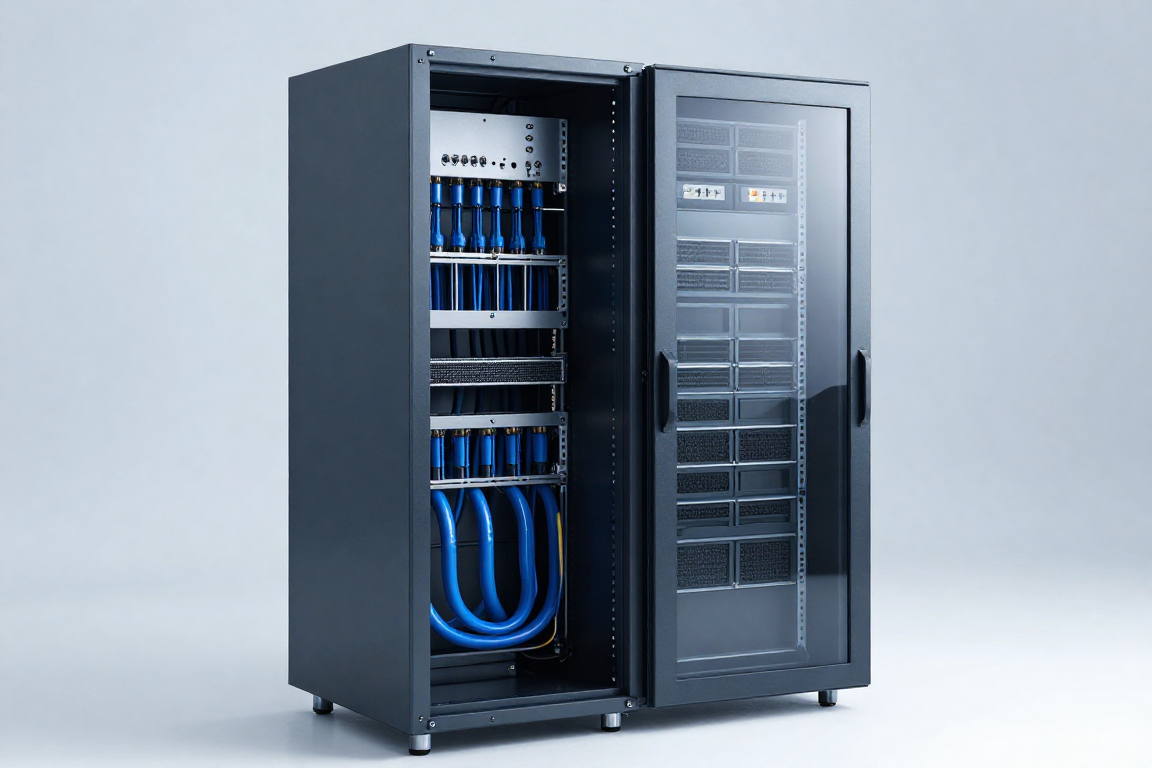
Liquid cooling (direct-to-chip, "DLC") moves heat away from CPUs and GPUs with a water-glycol loop through metal plates mounted on the chips, capturing 60-80% of server heat far more efficiently than air. A cabinet-level system has four parts: cold plates, a CDU (coolant distribution unit), a rack manifold, and dripless quick-disconnect couplings standardized by the Open Compute Project. Liquid cooling does not eliminate heat — it relocates it, so the deployment room still needs about 1.1× the IT load in air-conditioning capacity.
The one-sentence version
Instead of blowing air over heatsinks, liquid cooling moves heat away with a fluid loop — water-glycol through metal plates mounted directly on the chips (direct-to-chip, "DLC"), which captures 60-80% of server heat far more efficiently than air ever can.
The four parts
| Part | What it does |
|---|---|
| Cold plate | Metal block bolted to the CPU/GPU; fluid channels inside pick up heat directly |
| CDU (coolant distribution unit) | Pumps fluid around and hands heat to a heat sink — either facility water (liquid-to-liquid) or room air (liquid-to-air, "L2A") |
| Manifold | The rack's supply/return spine; good ones are blind-mate — servers connect by sliding in |
| Quick disconnects (UQD) | Dripless couplings standardized by the Open Compute Project, so parts interoperate across vendors |
The fluid
Small systems typically use PG25 (75% water / 25% propylene glycol): cheap, non-flammable, and free of the PFAS regulatory storm hitting fluorinated fluids — 3M exited that chemistry entirely at the end of 2025.
What liquid cooling does NOT do
It does not destroy heat; it moves it. Liquid-to-air cabinets dump heat into the room, so the room still needs air conditioning sized for ~1.1× the IT load. Anyone telling you otherwise is selling, not engineering.
Try the loop
Everything above, live: drag the load, the capture ratio, the room and the coolant — watch the flow speed, the heat out and the capacity verdict react. Same physics as the playground tools, embedded right where you are reading.
flow 54 L/min (ΔT 8 °C) · liquid 30.0 kW · air 10.0 kW — same models as the flow, capture and derating pages
Frequently asked questions
What is liquid cooling?
Liquid cooling is a heat removal method that circulates a water-glycol fluid through metal plates (cold plates) mounted directly on CPUs and GPUs, absorbing chip heat and carrying it to a coolant distribution unit, which hands it off to facility water or room air. In data centers it usually means direct-to-chip (DLC) cooling, not full immersion.
What are the main components of a liquid cooling system?
Four parts: cold plates on the chips, a CDU (coolant distribution unit) that pumps the loop and rejects heat, a rack manifold that distributes supply and return lines, and dripless quick-disconnect (UQD) couplings standardized by the Open Compute Project so components interoperate across vendors.
What coolant fluid is used in direct liquid cooling?
Small direct-to-chip systems typically use PG25 — a mixture of 75% water and 25% propylene glycol. It is cheap, non-flammable and PFAS-free, unlike fluorinated fluids, which face tightening global PFAS regulation (3M exited fluorinated fluid production at the end of 2025).
Does liquid cooling remove the need for air conditioning?
No. Liquid cooling moves heat; it does not eliminate it. A liquid-to-air (L2A) cabinet rejects heat into the room, so the room needs air conditioning sized for roughly 1.1× the IT load. Liquid-to-liquid systems move the requirement to facility water loops and dry coolers instead.
Which standards apply to liquid cooling in data centers?
The Open Compute Project (OCP) specifies UQD quick disconnects and ORv3 blind-mate manifolds; ASHRAE defines coolant temperature classes (W-series); IEC 62368-1 Edition 4 covers electrical safety including liquid-cooling clauses; and Singapore’s SS 726:2026 is the first national standard for liquid cooling in tropical climates.
Standards worth knowing
OCP Cooling Environments (UQD, ORv3 blind-mate manifold specs) · ASHRAE liquid cooling guidelines (W-classes) · IEC 62368-1 Ed.4 (electrical safety incl. liquid-cooling clauses) · SS 726:2026 (tropical liquid cooling, Singapore).